
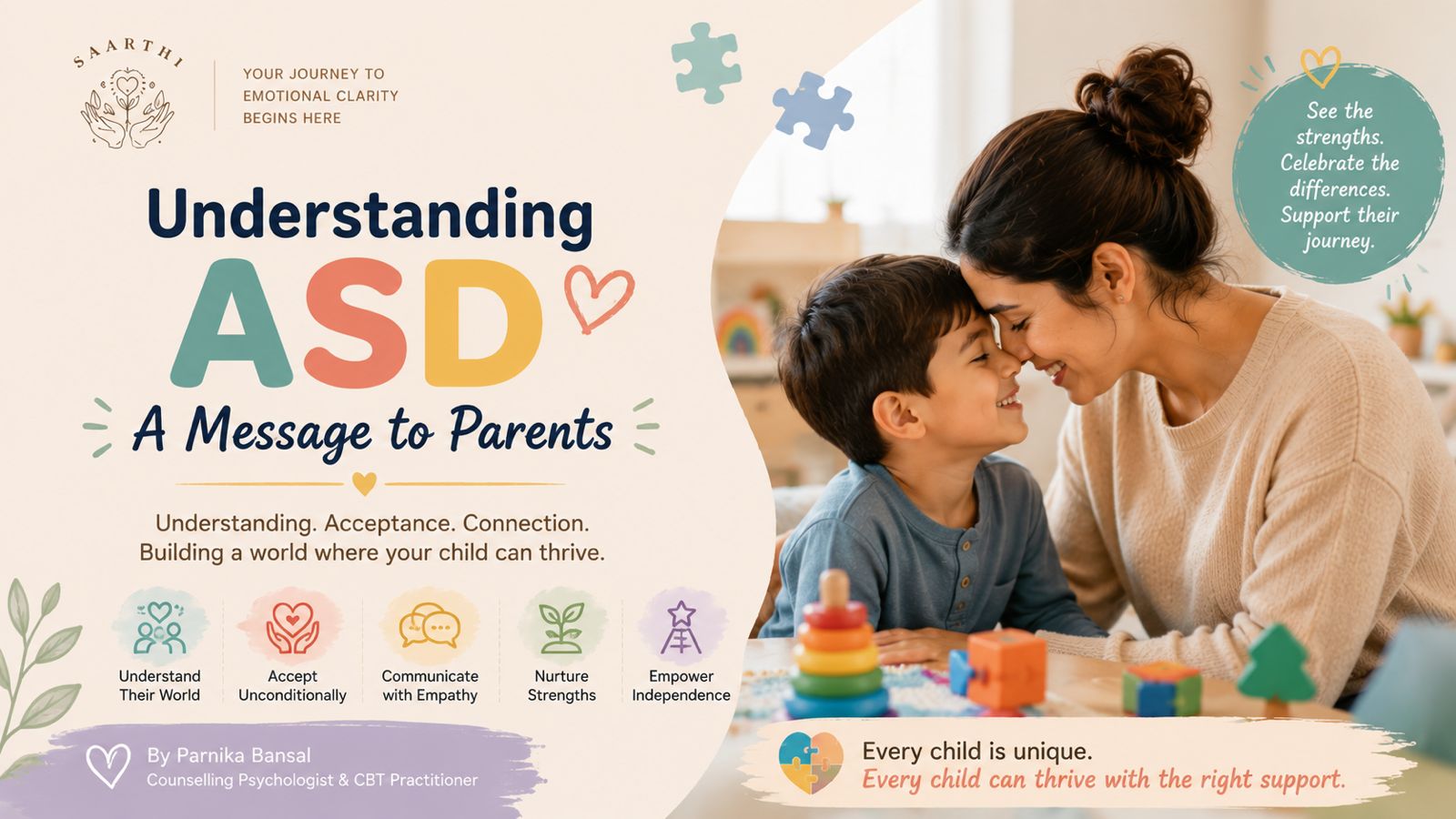
One of the most common questions I hear from parents after their child receives an Autism Spectrum Disorder (ASD) diagnosis is:
“Will my child be okay?”
Behind that question, I often hear many others:
“Will my child make friends?”
“Will they ever speak?”
“Will they be independent?”
“Did I do something wrong?”
And perhaps the most painful one:
“Why my child?”
If you are a parent standing at the beginning of this journey, I want you to know something important:
Your child is still the same child they were before the diagnosis.
The diagnosis has not changed who they are. It has simply given a name to the way they experience and interact with the world.
Understanding Autism Beyond the Labels
Autism Spectrum Disorder is a neurodevelopmental condition that affects social communication, interaction, behavior, and sensory processing.
But in my experience as a psychologist working with children and families, autism is much more than a clinical definition.
It is a child who may show love differently.
It is a child who may communicate in ways others do not immediately understand.
It is a child whose nervous system may experience sounds, lights, textures, or social situations more intensely.
It is a child who is trying every day to navigate a world that was not always designed with their needs in mind.
What I Wish Every Parent Knew !
When parents first come to me, they are often carrying enormous fear.
Fear of the future.
Fear of judgment.
Fear that their child will struggle.
Fear that they are somehow failing.
What I want every parent to hear is this:
Your child does not need a perfect parent. They need a parent who is willing to understand them.
Progress does not begin with changing your child.
Progress begins with understanding how your child experiences the world.
Looking Beyond Behaviors
Many autistic children are described as:
- “Stubborn”
- “Difficult”
- “Defiant”
- “In their own world”
- “Not listening”
But when we slow down and look deeper, we often discover something different.
A child who appears stubborn may be overwhelmed by uncertainty.
A child who avoids eye contact may still be listening carefully.
A child who has a meltdown may be experiencing sensory overload rather than misbehavior.
A child who repeats phrases may be communicating in the way their brain currently knows how.
Behavior is often communication.
When we understand the message behind the behavior, our response changes completely.
The Goal Is Not to Make an Autistic Child Look Neurotypical
This is something I feel strongly about.
The goal of therapy should never be to erase a child’s personality, uniqueness, or authentic way of being.
The goal is to help them:
- Communicate their needs
- Build meaningful relationships
- Develop independence
- Understand emotions
- Navigate challenges
- Feel confident in who they are
Therapy should help a child thrive – not force them to become someone else.
Progress Often Looks Different Than Parents Expect
Sometimes parents are waiting for the “big milestones.”
The first conversation.
The first friendship.
The first independent activity.
But as a psychologist, I have learned to celebrate the smaller victories.
A child who tolerates a new texture.
A child who asks for help instead of crying.
A child who shares attention for a few extra seconds.
A child who expresses a feeling for the first time.
These moments may seem small to others.
They are not small.
They are building blocks of growth.
To the Parent Reading This
I know this journey can feel overwhelming.
I know there may be days when you question whether you are doing enough.
I know there may be moments of grief for the expectations you once had.
But I also want you to know this:
I have seen children surprise their parents in ways they never imagined.
I have seen families grow stronger.
I have seen communication emerge.
I have seen confidence develop.
I have seen children flourish when they are understood instead of judged.
Your child’s path may look different from what you expected.
Different does not mean less.
Different does not mean impossible.
Different does not mean hopeless.
My Message as a Psychologist
If I could leave every parent of an autistic child with one thought, it would be this:
Stop asking, “How do I change my child?” and start asking, “How can I understand my child better?”
That shift changes everything.
Because children grow best when they feel accepted.
They learn best when they feel safe.
And they thrive best when the adults around them choose connection over correction.
At Saarthi Emotional Wellness, my goal is not only to support children but also to walk alongside parents as they learn, adapt, and discover the incredible strengths their child already possesses.
Every child deserves to be understood.
Every parent deserves support.
And every journey deserves hope.